Crime & Law
No Verdict in Madigan Corruption Trial After 10th Day of Jury Deliberations
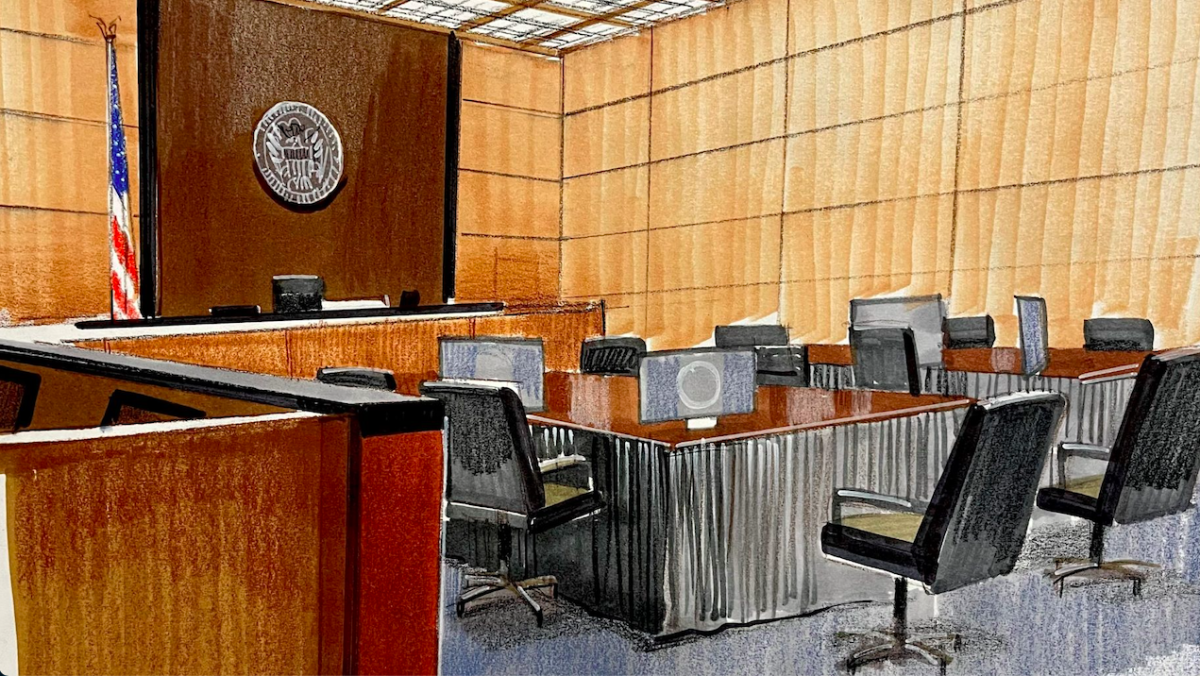 An empty courtroom on the 12th floor of the Dirksen Federal Building, where jurors will return their verdict in the trial of ex-House Speaker Michael Madigan. (Illustration by Cheryl Cook)
Jurors in the corruption case of former Illinois House Speaker Michael Madigan and his longtime friend and ally Michael McCain have surpassed 60 hours of deliberations as they continue working their way toward a verdict after months of testimony and evidence.
The jury of eight women and four men began deliberations late on Jan. 29. They have now completed 10 days of discussions without yet reaching a verdict.
Madigan and McClain face charges of racketeering, federal program bribery and wire fraud. Madigan is also accused of attempted extortion. Both men have pleaded not guilty.
After a flurry of notes to kick off their deliberations, jurors were largely quiet over the following week, with several full days passing without any communications whatsoever.
Only minutes after being sent off to begin their discussion, jurors informed the court that they had already picked a foreman and set out a deliberation schedule that included Fridays — which had been given to jurors as a day off throughout the monthslong trial.
They also asked for additional pens, highlighters and tape, before following up the next day with a request for Wite-Out and sticky notes, leading U.S. District Judge John Blakey to quip that it appeared there was “some kind of arts and crafts going on back there.”
The jury was silent on Day 3 and broke for the weekend before asking on Day 4 for aid finding an exhibit detailing a phone call in which McClain spoke about the possibility of Juan Ochoa being appointed to a board seat with utility giant Commonwealth Edison.
That marked the first substantive note, which gave a look into where jurors were at in their deliberations — in this case, the ComEd bribery allegations, which make up counts two through seven of the indictment.
The jury last week eventually shortened its schedule, informing the court jurors would begin leaving at 4:30 p.m. each day, before asking their most in-depth question thus far last Friday on Day 8 of deliberations.
In that note, jurors asked for clarification about whether a “bona fide salary” could be considered a “thing of value.” Instructions given to jurors on various bribery counts stated that a “bona fide” salary paid “in the usual course of business” wouldn’t qualify as “a thing of value” as part of a bribe.
In crafting a response, U.S. District Judge Edmond Chang — who filled in for an “unavoidably absent” Blakey that day — reiterated that salaries paid in the usual course of business should not qualify as “a thing of value,” but that payments made for a job obtained through bribery are not made in the usual course of business.
Madigan and McClain’s defense teams later filed a motion seeking an additional instruction to clarify the government’s burden to prove this point, but Blakey — who returned to court Monday for Day 9 of deliberations — rejected that request.
The only word from jurors Tuesday was a brief note at 3 p.m. indicating they had “reached (their) limit for today” and wanted to leave early and “start fresh” on Wednesday.
Already the Madigan jury has deliberated far longer than a pair of juries in other recent high-profile corruption and bribery cases heard at the Dirksen Federal Building.
The federal jury that convicted longtime Chicago Ald. Ed Burke in his own corruption case deliberated for approximately 23 hours, while deliberations in the “ComEd Four” trial — in which McClain and three others were convicted of conspiring to bribe Madigan — lasted around 27 hours.
The Madigan and McClain jury has topped those two totals combined.